Review · SHORE EXCURSIONS
Shore Excursion from Salaverry port
Ancient adobe cities await beyond Salaverry. This five-hour shore excursion packs several of northern Peru’s most important archaeological sites into one port-friendly day, with round-trip transport, a bilingual guide, and visits to the Moche and Chimú centers near Trujillo. I especially like the excellent mix of sites and the way guides such as Alfredo and William bring order and context to a busy schedule. I also like that the tour handles transport from the port, a major help when your ship’s departure time is fixed.
The main point to watch is the cost structure: the $80 price covers transport and guiding, but entrance fees, food, and drinks are extra. The advertised duration is five hours, although one recent outing lasted seven hours, so you should confirm the timetable carefully and leave a safe buffer before your ship sails.
Key points to know before you book
- Four major archaeological stops: See the Moche temples of the Sun and Moon, the Huacas de Moche Museum, Huaca Arcos Iris, and Chan Chan.
- Moche and Chimú cultures in one outing: The guide explains how these two northern Peruvian powers differed in religion, government, and city design.
- Strong guiding is central to the experience: Alfredo and William have been praised for clear English, friendly manner, good organization, and well-timed explanations.
- Port transport is included: You travel from Salaverry and return there after the sightseeing.
- Allow extra time for entrance costs: The $80 fee does not include admission, meals, drinks, or personal insurance.
- The meeting point is outside the port shuttle: Take your ship’s shuttle to Salaverry Plaza and look for the JD ADVENTURE sign.
Why this is one of Salaverry’s better shore excursions
Salaverry itself is mainly your arrival point. The real reason to book this outing is the chance to reach the archaeological zone around Trujillo without trying to arrange separate taxis, tickets, and timing on your own.
In a short visit, you see two civilizations that shaped this part of Peru. The Moche built large ceremonial and administrative centers before the Chimú created Chan Chan, one of the biggest adobe cities in the pre-Columbian Americas. That makes the itinerary more satisfying than a single-site visit. You are not simply looking at old walls. You are comparing different ways of worshipping, ruling, building, and organizing urban life.
I also like the scale of the plan. It does not spend the whole day at one ruin, yet each stop has a clear purpose. The Sun and Moon temples show Moche power and ritual. Huaca Arcos Iris introduces Chimú religious imagery in a smaller setting. Chan Chan then gives you the broad city picture.
The tradeoff is speed. Four sites in about five hours means the pace is purposeful. You will have time to see the main areas and listen to explanations, but this is not a slow archaeological study. If you want long photography stops or quiet time at every wall, the schedule may feel tight.
A few more shore excursions around the world worth a look
- FOR CRUISERS: Skip The Lines PRIVATE EPHESUS TOUR &On Time Return
★ 5.0 · 8,527 reviews - Top Choice For Cruisers: Ephesus, Mary’s House WITH TICKETS+LUNCH
★ 5.0 · 7,233 reviews - PRIVATE EPHESUS TOUR FOR CRUISERS: On-time Return and Skip-Line
★ 5.0 · 5,807 reviews
Getting from Salaverry port to the archaeological sites
Your ship provides a shuttle bus from the port. The ride to the meeting point at Salaverry Plaza takes about 10 minutes. Once there, look for the JD ADVENTURE sign.
This detail matters. The tour vehicle does not meet you deep inside the cruise terminal, so do not assume you can simply walk out and find the guide beside the ship. You must use the ship’s shuttle first. The operator says full meeting instructions are sent two days before arrival, and you should provide a working mobile number so the company can contact you through WhatsApp.
You should also send the name of your ship, arrival time, and departure time. Keep checking your email for any change to the meeting or departure schedule. A ship excursion is only useful if it gets you back on board, so this communication is not a minor formality.
The included vehicle is described as small-group transport. The exact group size is not given, but the setup should be more personal than a large coach tour. English and Spanish guiding is available.
Huaca del Sol and Huaca de la Luna: two very different Moche centers
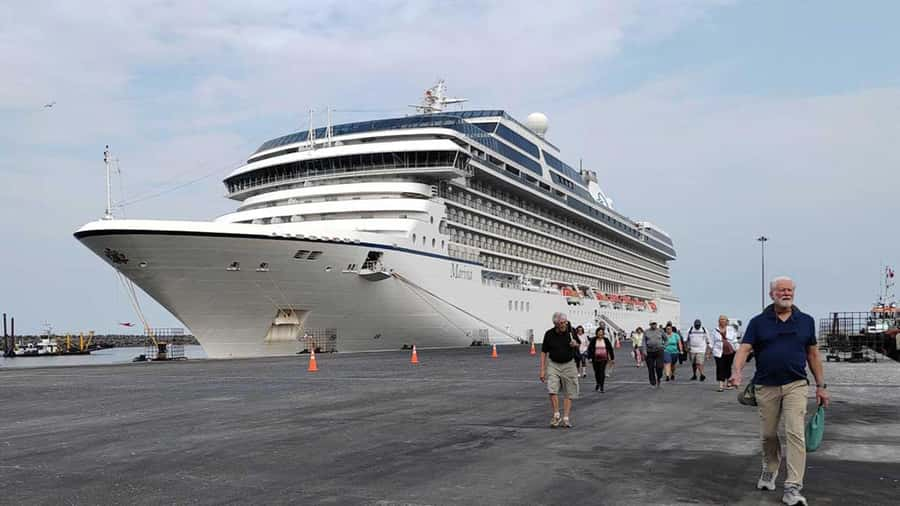
The first major stop is the Moche complex known as the Huacas del Sol y de la Luna, or Temples of the Sun and Moon. These huge adobe structures can look like simple earthen hills at first glance. Their scale makes more sense once you learn how they were built.
Huaca de la Luna served as a religious complex. Huaca del Sol was used as an administrative center. Together they reveal that the Moche organized both ceremonial life and government on a large scale.
The temples grew in stages across roughly 700 years. When a Moche ruler died, his burial was sealed into the existing structure, and a new platform was built over it. Each generation added another layer. The result was a stepped pyramid formed over centuries, not a single building completed at one time.
That detail gives you a useful way to read the site. You are seeing a place that changed with each generation, with older activity hidden beneath later construction. The guide’s explanation is especially useful here because the ruins alone do not immediately show how the platforms developed.
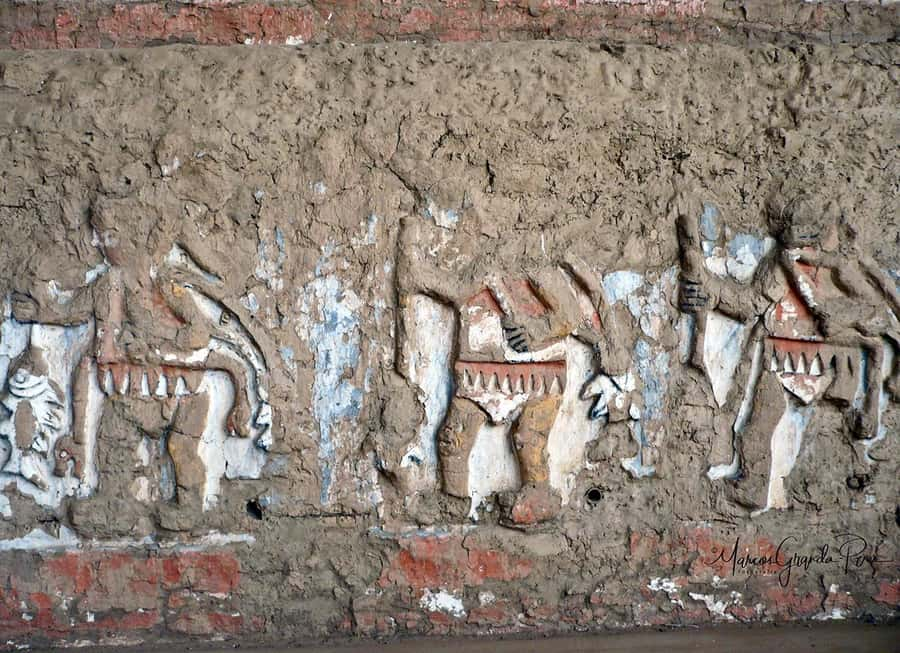
Huaca de la Luna is generally the more visually rewarding of the two temples because it was a religious center with decorated surfaces and ceremonial areas. The exposed adobe walls and carved or painted details help you understand that these were not plain mounds. They were active places with strong visual messages.
Huaca del Sol is important for a different reason. Its role as an administrative center points to the practical side of Moche power: collecting goods, organizing labor, and controlling territory. You may not experience it in the same detailed way as the religious complex, but seeing both huacas together gives the visit its strength.
Expect sun, dust, and uneven ground. The outing is not a good fit for people with mobility impairments, and the operator also lists pregnancy, certain pre-existing medical conditions, altitude sickness, and an age over 95 among restrictions. Bring cash, and wear practical clothing for an outdoor archaeological site. Backpacks are not allowed, so pack lightly.
The Huacas de Moche Museum adds the missing details
The nearby Huacas de Moche Museum helps put the ruins into human terms. Its collection includes ceramics, utensils, artifacts, and tombs connected with the Moche complex.
I find a museum stop particularly valuable after seeing the temples. At the ruins, you are looking at adobe platforms and ceremonial spaces. In the museum, you can see the objects that made those places function: vessels, tools, ritual items, and burial material.
This is also where a good guide can make a real difference. Alfredo has been praised for clear English, friendliness, and strong command of the subject. William has received similar praise for giving information at the right place and time instead of delivering long, unfocused speeches. That style suits an archaeological tour. You get an explanation when the object or structure is in front of you, rather than trying to remember a lecture later.
The museum is not an optional decorative stop. It balances the outdoor visit. If you skip it, the Moche story remains more abstract. With it, the people behind the temples become easier to picture.
Same port, a different day ashore:
- From the Port of Kos: Full Day Boat Cruise to 3 Islands
★ 4.8 · 5,137 reviews - Hilo Shore Excursion: Volcanoes National Park & Black Sand Beach
★ 4.5 · 2,338 reviews - Arrecife: Timanfaya and Green Lagoon for Cruise Passengers
★ 4.6 · 2,010 reviews - For cruise passengers: Guided ATV Tour of Dutch & French St. Maarten
★ 5.0 · 1,552 reviews
Huaca Arcos Iris and the story of El Dragon
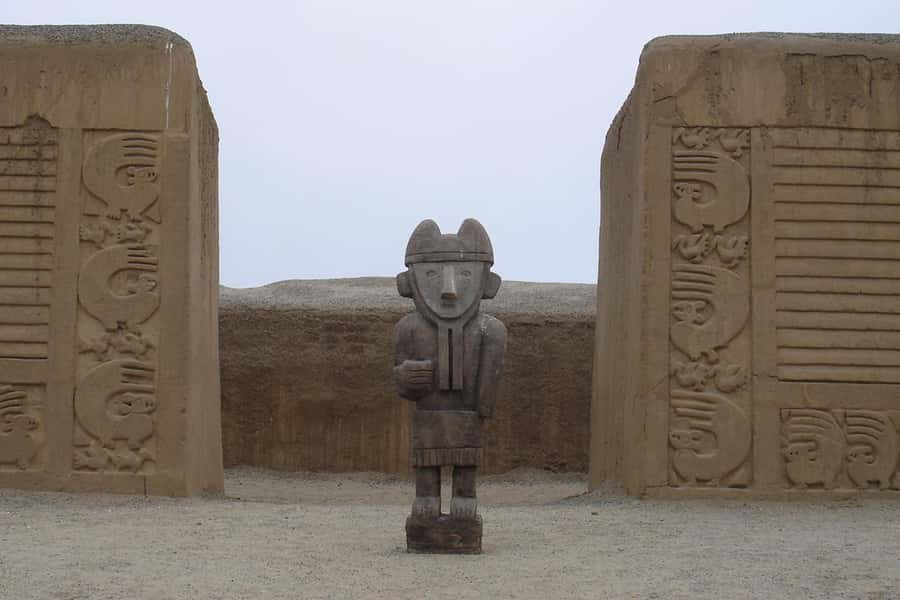
The route continues to Huaca Arcos Iris, also called the Rainbow Temple or El Dragon. This temple was built by the Chimú around A.D. 1200, making it a useful bridge between the Moche sites and Chan Chan.
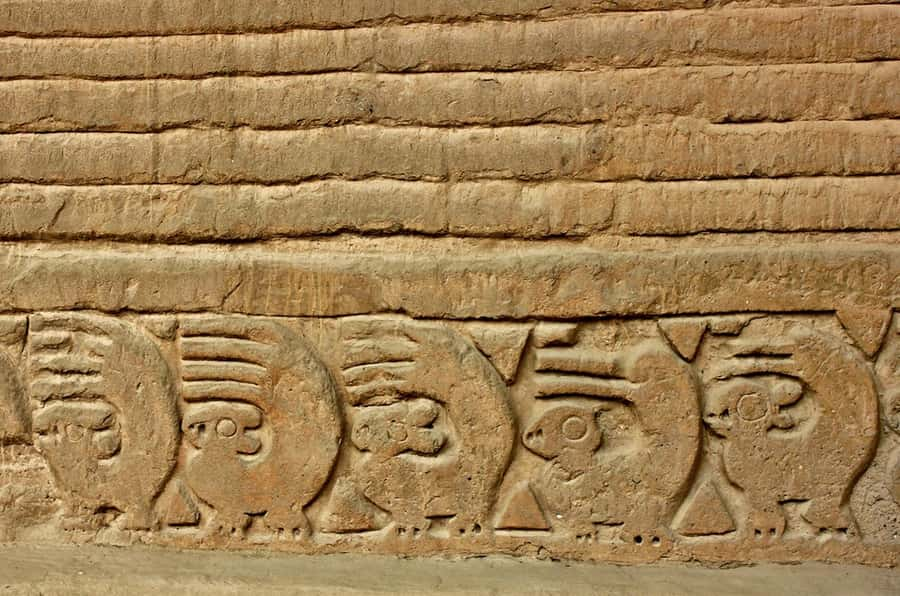
The site has two platforms with carved adobe panels and niches. These niches once held ritual objects, and the carved designs show the Chimú use of repeated symbols and strong geometric decoration. Because the structure is smaller than the major Moche huacas, you can often understand its layout more quickly.
Huaca Arcos Iris also carries a traditional story. Local legend identifies it as the home of Takaynamo, the mythical founder of Chan Chan. You should treat that as legend rather than documented fact, but it adds a human layer to the ruins. Ancient cities are not only collections of dates and building methods. They also carry stories about founders, rulers, and sacred beginnings.
The stop is worthwhile because it gives you a different architectural experience. The Moche temples feel massive and layered. El Dragon is more compact and defined by carved adobe decoration. The contrast helps you see that Moche and Chimú culture were not interchangeable, even though both built with adobe in the same broad region.
Chan Chan: the largest adobe city in the Americas
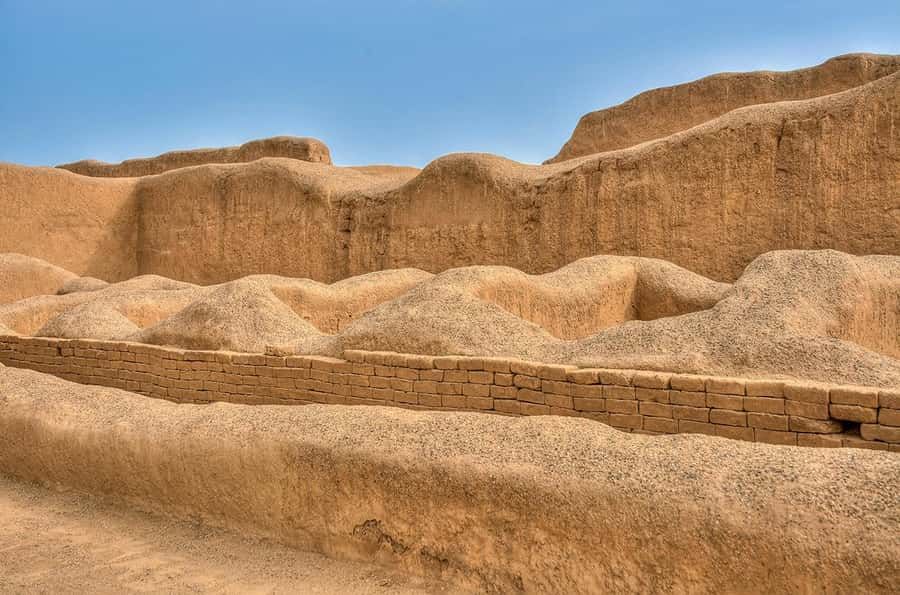
The final main stop is Chan Chan, the former capital of the Chimú empire. The archaeological complex is recognized as a UNESCO World Heritage Site and is described as the largest pre-Columbian adobe city in the Americas.
Chan Chan was not just one palace or temple. It was a full urban center with courtyards, terraces, palaces, and gardens. Estimates suggest that between 30,000 and 60,000 people once lived there.
That scale is the point of the visit. At Huaca Arcos Iris, you see a temple. At Chan Chan, you begin to understand the city that supported an empire. The surviving walls outline a planned world of enclosed spaces, ceremonial areas, and royal compounds.
Adobe is also the source of both Chan Chan’s power and its fragility. Earth construction allowed the Chimú to create broad walls and large compounds, but rain and weather can damage exposed adobe. The site therefore rewards close attention to surviving reliefs and wall patterns rather than expectations of intact stone buildings.
Do not compare Chan Chan with a granite city such as Machu Picchu. Its beauty comes from scale, geometry, earthen construction, and the sense of a once-organized capital spreading across the plain. The guide’s context matters here, since it helps you imagine how courtyards, palaces, terraces, and gardens once worked together.
The visit may feel too short if you want to inspect every enclosure. Still, as the final stop, Chan Chan gives the day a strong finish. You have already seen Moche religious and administrative centers, then a Chimú temple, and now the Chimú capital.
Guides Alfredo and William set the tone
The guide can make or break an archaeology outing, and this tour has received particularly strong praise for its guiding. Alfredo is described as friendly, clear in English, and well informed about the sites. William is praised for being structured, capable, and sensitive to the group’s attention.
That last quality is worth noting. At ruins, a guide can easily speak for too long while you stand in the heat trying to see the wall being discussed. The better approach is to explain the right detail at the right spot, then let you look. William’s approach has been described in exactly those terms.
The tour is offered in English and Spanish. You should confirm your preferred language when booking. If you enjoy cultural context but do not want a nonstop lecture, the reported guiding style is a good sign.
The current score is 4.5 out of 5 from eight ratings, with several top marks for the guides, organization, and range of sites. One outing also included a ceviche meal with an ocean view at the end, but food is not included in the stated price, so do not count on that as part of the standard program.
Is $80 good value for a port day?
At $80 per person, the tour is not the cheapest way to see Trujillo’s archaeological sites. Yet the value is fairly strong if you want a controlled shore excursion rather than arranging transport independently.
Your fee includes pickup and return to Salaverry port, a bilingual guide, and small-group transportation. Those elements remove several practical worries. You do not need to negotiate a taxi, calculate separate travel times between distant sites, or work out how to return to the ship.
The extra costs are important. Entrance fees are not included, and neither are food, drinks, or personal travel insurance. Bring cash for admissions and any meal or drink you choose to buy.
The advertised duration is five hours. One recent experience took seven hours and covered the full set of sites, so ask for the exact planned return time before departure. A longer outing can be pleasant, but only if your ship’s schedule allows it.
Who should book this excursion?
I would recommend it to you if you want a concentrated introduction to Moche and Chimú culture, especially if this is your only stop in the Trujillo area. It suits people who value a guide’s interpretation as much as the ruins themselves.
It is also a good fit for cruise passengers who prefer not to manage local transport. The port pickup and return are the practical heart of the package.
You should think twice if you dislike a full schedule, need extended rest stops, or have difficulty with uneven outdoor surfaces. The operator specifically says the tour is not suitable for pregnant women, people with mobility impairments, people with altitude sickness, certain pre-existing medical conditions, or people over 95.
Pets, backpacks, alcohol, and drugs are not allowed. Keep your luggage small and bring cash. Cancellation is free up to 24 hours before departure, and you can reserve now and pay later, which helps when your ship schedule is still subject to change.
My booking verdict
Book this excursion if you want the most archaeological value from a short Salaverry port call. The combination of Huaca de la Luna, Huaca del Sol, the Moche museum, Huaca Arcos Iris, and Chan Chan gives you a much fuller picture than visiting one ruin alone.
I especially like the cultural range and the strong reports about Alfredo and William. Just budget for admission and food, confirm the return time, and remember that five hours may feel brisk. For a first look at the ancient centers around Trujillo, this is a well-planned choice with enough substance to justify the price.
FAQ
Where does the tour meet at Salaverry port?
You must take the cruise ship’s shuttle bus from the port to Salaverry Plaza. The ride takes about 10 minutes. At the plaza, look for the JD ADVENTURE sign.
What time does the excursion begin?
The stated start time is 8:30 a.m. You should keep checking your email for updates and provide your ship’s arrival and departure details.
How long does the tour last?
The advertised duration is five hours. One recent outing lasted seven hours, so confirm the expected return time before you leave the ship.
What sites are included?
The route includes Huaca del Sol, Huaca de la Luna, the Huacas de Moche Museum, Huaca Arcos Iris, and Chan Chan.
Is Chan Chan a UNESCO World Heritage Site?
Yes. Chan Chan was declared a UNESCO World Heritage Site in 1986.
Are entrance fees included in the $80 price?
No. Entrance fees are not included. Food, drinks, and personal travel insurance are also extra.
Is transportation from the port included?
Yes. The experience includes round-trip transportation from and back to Salaverry port, along with an English and Spanish speaking guide.
What should I bring?
Bring cash. Backpacks are not allowed, and pets, alcohol, and drugs are prohibited. You must also provide a valid mobile number for WhatsApp contact and the full details of your ship’s arrival and departure.
Just added around the world
- Marseille Shore Excursion: Private Day Trip to Arles, Les Baux de Provence and Saint Remy de Provence★ 4.0 · 5 reviews
- Marseille E-Bike Shore Excursion to Calanques National Parc★ 4.5 · 23 reviews
- Small Group Marseille Shore Excursion: Luberon Villages Tour★ 4.5 · 22 reviews
- Marseille Shore Excursion – Full Day Wine Tour in Provence★ 5.0 · 29 reviews
- Small Group Marseille Shore Excursion : Avignon & Chateauneuf du Pape Wine Tour★ 4.5 · 22 reviews
- Marseille Cruise Port ⟺ CASSIS (RoundTrip)★ 5.0 · 2 reviews
- Marseille One Day Tour Designed for Cruise Passengers★ 4.5 · 4 reviews
- Small Group Marseille Shore Excursion: Aix-en-Provence & Cassis★ 4.5 · 37 reviews
Shore Excursions, compared.
FOR CRUISERS: Skip The Lines PRIVATE EPHESUS TOUR &On Time Return
Read our review →
Top Choice For Cruisers: Ephesus, Mary’s House WITH TICKETS+LUNCH
Read our review →
PRIVATE EPHESUS TOUR FOR CRUISERS: On-time Return and Skip-Line
Read our review →
Hilo Shore Excursion: Volcanoes National Park & Black Sand Beach
Read our review →
Arrecife: Timanfaya and Green Lagoon for Cruise Passengers
Read our review →
For cruise passengers: Guided ATV Tour of Dutch & French St. Maarten
Read our review →