
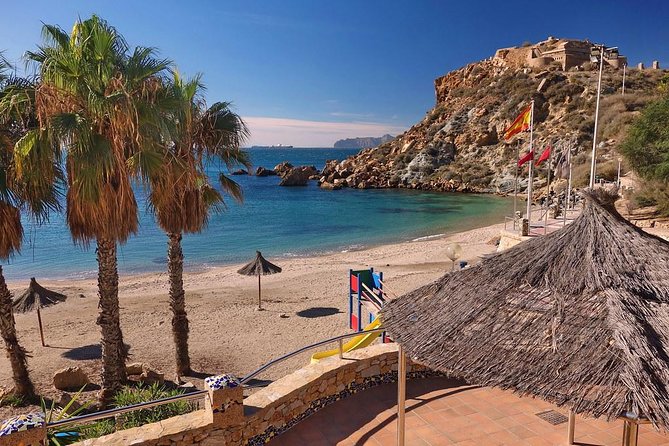
Review · CARTAGENA SHORE EXCURSIONS
Private 4-hour Shore Excursion of Cartagena with driver and official guide
Cartagena rewards curious visitors. This private four-hour tour connects the city’s Roman, Carthaginian, naval, and modernist sides without making you arrange each stop yourself. I like the Roman Theater Museum, where the ruins and exhibition work together, and I like having a private guide and vehicle for a cruise-day visit. The main drawback is the price: at $487 per person, it makes the most sense for a small group that values comfort and personal attention.
The schedule is full, with several stops listed at 15 to 45 minutes each. Guide David receives especially warm praise for his friendly teaching style, though one visit included difficulty with English and a serious communication problem with the driver. The operator says that driver was removed, but I would still confirm your guide’s English and the exact vehicle arrangements before departure.
Key points at a glance

- Roman Theater Museum included: Spend about 40 minutes inside Cartagena’s finest ancient monument, with the museum designed by Rafael Moneo.
- Private transport and guide: Your group receives a vehicle, driver, and official guide for four hours, with pickup at the cruise port, hotel, or another Cartagena location.
- A broad view of Cartagena: The route covers Roman, Carthaginian, naval, underwater, medieval, and modernist history.
- Several entry fees are extra: The Roman Theater is included, but tickets for the castle, Punic Wall, and National Museum of Underwater Archaeology are not.
- A busy half-day: The listed stops add up to roughly three hours and 20 minutes before driving, walking, and transitions.
- Best for small groups: The high per-person cost is easier to justify when shared by family or friends who want a private schedule.
Cartagena in four hours: what this tour is really offering
Cartagena is unusually rewarding for a short port visit. Roman remains sit beneath modern streets, Carthaginian walls survive beside later religious buildings, and the harbor connects the city to Spain’s long naval story. You can see a lot in four hours, but you need a plan.
This excursion gives you one. Pickup is available at the cruise port, your hotel, or another chosen place in Cartagena. A private vehicle handles the longer connections, while an official guide leads the sightseeing. That matters on a cruise stop, when a missed connection or a poorly timed museum visit can eat into your day.
The tour is advertised as private, meaning only your group participates. You are not locked into the pace of a large coach party. If your group wants more time at the Roman Theater and less time at the naval museum, ask in advance. The published schedule is fairly packed, so flexibility may depend on the day’s timing and the guide.
The listed route includes the Museo Naval, Castillo de la Concepción, Roman Theater Museum, Cartagena’s City Hall, an 18th-century building on the main pedestrian street, Cerro del Molinete Archaeological Park, the Punic Wall, and ARQUA, the National Museum of Underwater Archaeology. Not every stop receives a long visit. Some are exterior views or brief introductions, so think of this as a carefully packed overview rather than a slow museum day.
More Private Shore Excursions in Spain
- Private Excursions For Cruise Ship Passengers
★ 4.5 · 110 reviews - Palma de Mallorca Shore Excursion: Private Tour of Valldemossa, Soller and Serra de Tramuntana
★ 5.0 · 65 reviews - Private Shore Excursion to Valldemossa and Palma de Mallorca
★ 4.5 · 43 reviews
Museo Naval: Spain’s maritime story in 40 minutes
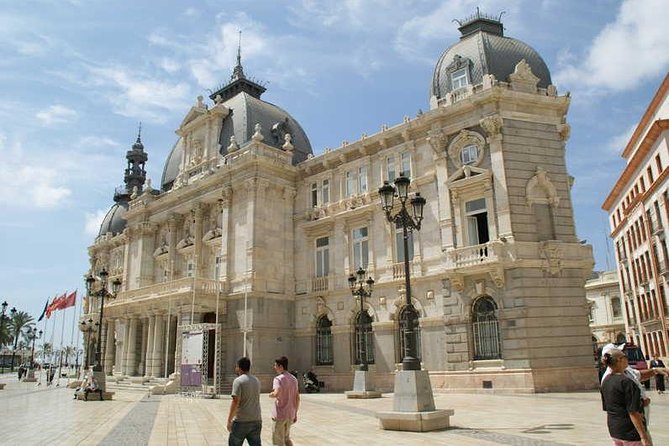
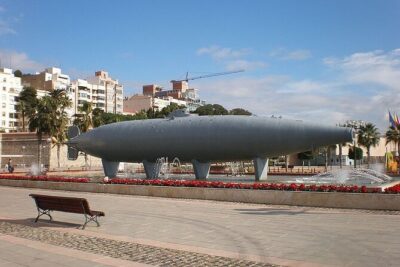
The Naval Museum opens the tour with a wide look at Spain’s relationship with the sea. Its subjects include the Spanish Navy, shipbuilding, navigation, cartography, nautical instruments, maritime voyages, underwater archaeology, and less tangible parts of maritime culture.
You receive about 40 minutes here, with admission included at no extra cost. That is enough for a focused introduction, but not enough to study every display at length. Your guide can help you decide what deserves attention, especially if naval technology or Spanish exploration interests you.
This stop also gives useful context for Cartagena itself. The city is not simply an ancient Roman site with a port attached. Its harbor has supported military and commercial activity across many centuries. I would treat the museum as a good scene-setter, not the central reason to book the excursion.
Castillo de la Concepción and the city view
The route then moves uphill toward Castillo de la Concepción, also called the Castle of Asdrubal. The plan includes the panoramic elevator to Torres Park and an exterior view of the castle, with roughly 20 minutes at the stop.
The castle dates from the medieval period, generally the 13th or 14th century, though it was built over earlier Roman and Arab structures. From the Arab period, the surviving lantern once served as a lighthouse. That detail helps explain why this hill mattered long before it became a place for city views.
The panoramic elevator is practical for a short visit because it avoids turning the hill into a tiring climb. Your reward is a higher view over Cartagena, useful for understanding how the old city sits around its harbor and hills. The castle admission is not included, so you should not expect a full interior visit unless you arrange and pay for that separately.
At only 20 minutes, this is a quick orientation stop. I like its place in the schedule because you see the city from above before walking through its historic center. If views are a priority, tell your guide. If you prefer interiors, you may want to ask if the time can be adjusted.
The Roman Theater Museum: the tour’s strongest stop
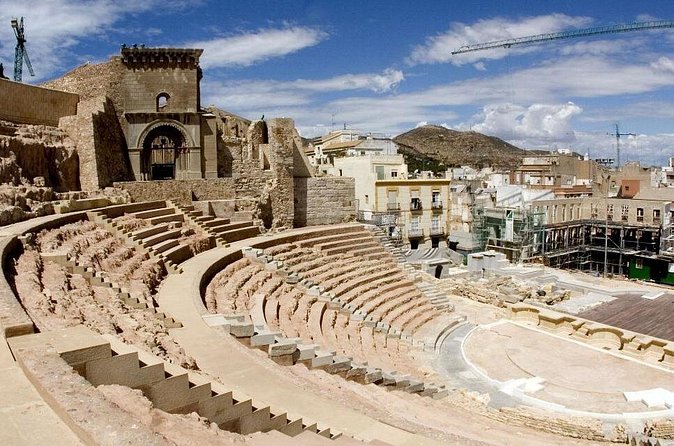
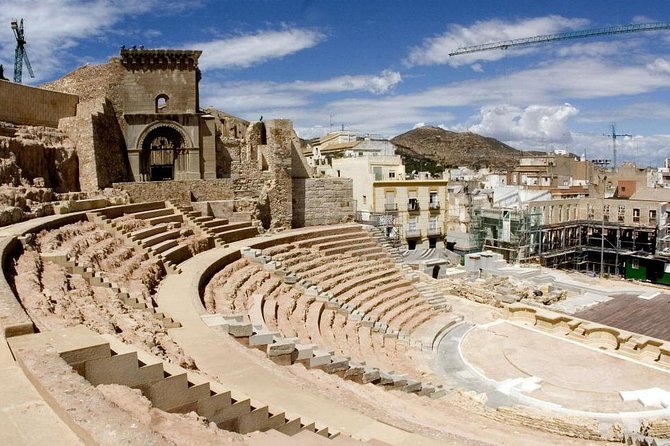
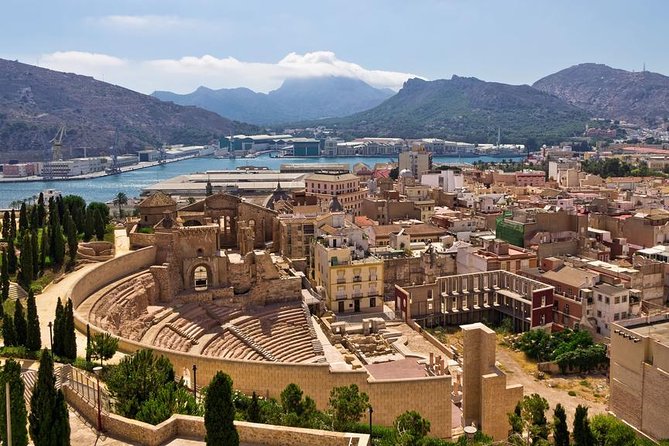
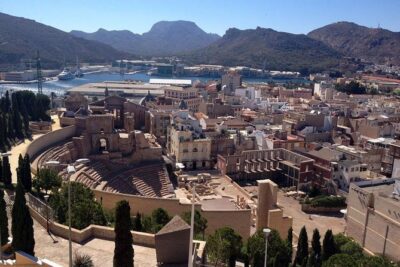
The Roman Theater is the centerpiece. Built between 5 and 1 BC, it held about 7,000 spectators and remained in use until the third century. Later buildings covered much of it, and the monument was not excavated until 1988.
The museum, designed by architect Rafael Moneo, leads you into the theater rather than presenting it as an isolated ruin. That design is important. You do not just look at broken stone from a distance. The museum explains the site and brings you into the monument itself, turning the theater into the final gallery.
The visit lasts about 40 minutes, and admission is included. That makes this the clearest value in the package. If you have only one paid attraction in Cartagena, this is a strong choice because it combines architecture, archaeology, and the physical scale of Roman public life.
I also like that the theater is more than a standard photo stop. Its capacity tells you something about Roman Cartagena, known then as Carthago Nova. A city that could support a theater for thousands was a major regional center, not a minor provincial outpost.
Guide David has been praised for making this part warm, entertaining, and informative. That kind of guidance matters here because the theater’s later layers can be confusing without explanation. The best use of your time is to listen closely to how Roman buildings were covered, reused, and eventually exposed again.
Same port, a different day ashore:
- Arrecife: Timanfaya and Green Lagoon for Cruise Passengers
★ 4.6 · 2,010 reviews - Timanfaya And El Golfo For Cruise Passengers (Mornings)
★ 4.5 · 944 reviews - Lanzarote: Day Tour for Cruise Passengers
★ 4.7 · 860 reviews - Fuerteventura: Corralejo Sand Dunes Guided Shore Excursion
★ 4.6 · 335 reviews
City Hall and the old center’s grand façades
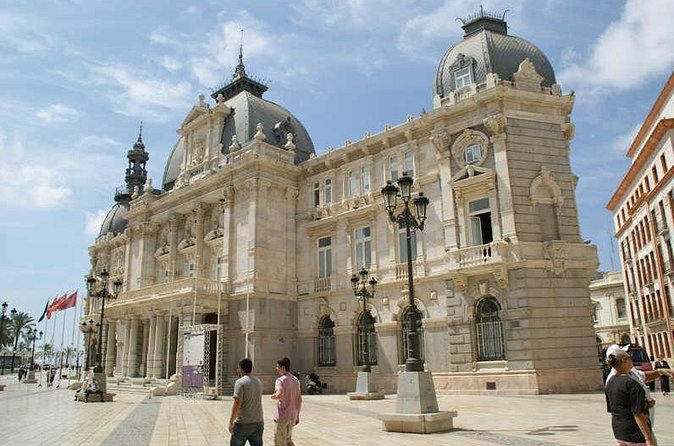
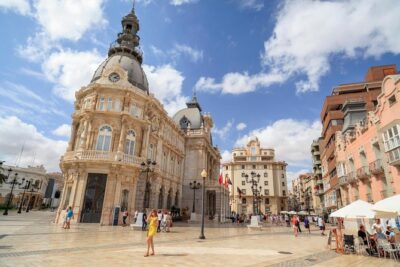
The route includes Cartagena’s Consistorial Palace, or City Hall, one of the city’s main modernist buildings. Built between 1900 and 1907, it has a triangular plan, a white marble façade, and zinc domes on the roof.
Look for the repeated city symbols, especially the Castle of the Conception and the mural crown. The mural crown is linked to the Roman general Scipio Africanus, who awarded it when he captured Carthago Nova. This is a small detail, but it connects the modern building to the city’s ancient identity.
The itinerary also includes an impressive 18th-century building on the main pedestrian street of the old center. The exact building is not identified, so you should view this as an exterior architecture stop rather than a guaranteed interior visit.
These brief city-center points are useful because they keep the tour from becoming a string of archaeological sites. You see how Cartagena presents its past through civic buildings, public symbols, and later urban design. The tradeoff is time. A private visit gives you a guide’s explanation, but the schedule does not suggest a long unhurried stroll.
Cerro del Molinete: Roman public life under the modern city
The Cerro del Molinete Archaeological Park offers another look at Carthago Nova. The Roman forum lay near the center of the city, where important roads met between the surrounding hills. Parts of it have been excavated beneath the area around present-day San Francisco Square.
The remains include a temple dedicated to Jupiter, Juno, and Minerva, the Augusteum, the curia where the colonial government met, later baths and a palestra, and a temple of Isis. Together, these fragments show how Roman Cartagena worked as a civic and religious center.
The planned visit lasts about 40 minutes, and admission is free. This is a good stop for you if you enjoy reading a city through its foundations. It is less immediately dramatic than the theater, so the guide’s explanation carries much of the value.
I would not expect a perfectly complete ancient forum. The site has been only partly excavated, and the remains require some imagination. That is normal for archaeology. You are seeing pieces of a Roman city, not a fully rebuilt stage set. A private guide can help you connect the walls, temples, and public spaces into something easier to picture.
The Punic Wall and the story of Qart Hadast
The Punic Wall introduces an older chapter, before Roman Cartagena. General Hasdrubal founded Qart Hadast in 229 BC, and the wall is one of the few surviving Carthaginian remains in Spain.
The planned visit is brief, about 15 minutes, and admission is not included. The wall is valuable less for its size than for its place in the story of the Punic Wars, the long struggle between Carthage and Rome that shaped the western Mediterranean.
Beside the wall is a burial crypt connected with the Hermitage of San José, built in the 16th and 17th centuries. Its walls contain a striking pictorial program known as the Dances of Death. This gives the stop an unexpected second layer: ancient military history beside later religious art and burial practice.
Because time is short, ask your guide to explain what you are seeing before moving on. This is one of the places where a few clear words can make a small archaeological site much more meaningful.
ARQUA and the Odyssey treasure

The National Museum of Underwater Archaeology, known as ARQUA, focuses on the study, protection, conservation, and presentation of Spain’s underwater cultural heritage. The planned visit lasts about 45 minutes.
Its most famous holding is the Odyssey treasure from the frigate Nuestra Señora de las Mercedes. The collection contains more than 570,000 gold and silver coins from the late 18th and early 19th centuries. That scale alone makes the museum a notable stop, especially if you are interested in shipwrecks, naval archaeology, or the legal and cultural questions surrounding sunken treasure.
Admission is not included, so budget for the ticket if you want to enter. The museum also creates a useful ending to the route. You begin with Spain’s naval institutions and finish with objects recovered from the sea, linking Cartagena’s port to underwater research and maritime preservation.
Forty-five minutes is enough for a strong introduction, but you may need more time if every gallery interests you. If the Roman Theater is your top priority, make sure the guide knows that before the day begins. The published route contains enough museums to fill the half-day quickly.
Is $487 per person fair value?
The price is $487 per person, which is high for a four-hour city visit. The value depends heavily on your group size and priorities.
You are paying for a private official guide, a private vehicle with driver, pickup and drop-off, local taxes, and admission to the Roman Theater Museum. For a family or group of friends, the privacy and direct transport may make the cost easier to accept. You avoid organizing taxis, walking between distant sites, and managing several separate tickets.
For one or two people, the price is harder to defend unless you place a high value on convenience. Several attractions require extra admission, and food and drinks are not included. You should also remember that the schedule includes brief exterior stops and transitions, not four uninterrupted hours inside museums.
The strongest value comes from the combination of private transport and a personal guide. Cartagena is walkable in parts, but the castle viewpoint and several archaeological sites create a more complicated half-day. A cruise passenger with limited time may find the arrangement worthwhile, particularly if a reliable return to the port matters.
Group discounts are offered, but the available details do not explain the exact savings. Ask for the final price for your party rather than assuming the per-person figure will remain unchanged.
Guide quality, language, and the driver concern
The guide can shape this experience more than any single building. David is specifically praised for being warm, entertaining, and good at explaining Cartagena’s past. Another visit found the guide well informed but somewhat challenged by English, so I recommend confirming the language level when you book.
There was also a complaint about a driver who was rude and could not communicate in English with the customer. The operator responded that the problem came from a language misunderstanding and said the driver had been removed from the company. That response is reassuring, but it also gives you a practical question to ask: who is driving your group now, and will the guide handle communication throughout the day?
The overall rating is 4.3 from four reviews, which is positive but based on a small sample. The strongest praise centers on the Roman Theater, the scenic view from the castle area, reliable pickup, and a comfortable pace for retirees. The one serious complaint concerns service behavior rather than the sights themselves.
For the smoothest visit, confirm three things before departure:
- The guide’s spoken English
- The current driver arrangement
- Which optional entrance tickets you want to buy
Who should book this Cartagena excursion?
I would recommend it to a small private group arriving by cruise, especially if you want a guide to explain the Roman and Carthaginian remains rather than simply photograph them. It also suits older visitors or anyone who prefers a vehicle between sites and a measured pace. One review specifically praised the rhythm for a group of retirees.
It is less suitable if you want a slow museum day. The route is ambitious, and the time at each place is limited. Independent visitors who enjoy walking and choosing one or two major sights may spend less by visiting the Roman Theater and city center on their own.
You should also be comfortable paying extra for some stops. The Roman Theater is included, but admission is not included for the castle, Punic Wall, or ARQUA. The Naval Museum and Cerro del Molinete are listed as free.
Free cancellation is available up to 24 hours before the start time. Changes or cancellations inside that window are not refunded, and the cut-off uses Cartagena’s local time.
Should you book it?
Book this tour if you want Cartagena’s major historical layers explained in one organized half-day, with port pickup, private transport, and a guide working at your group’s pace. The Roman Theater Museum, castle viewpoint, Punic Wall, and ARQUA give you a strong sense of why this port matters.
I would book it with two conditions: confirm the guide’s English and ask which entrance tickets you want included or arranged. At $487 per person, this is not a bargain tour. It is a comfort-and-context choice, best shared with a group that values an efficient route and a good explanation of what lies beneath Cartagena’s streets.
FAQ
How long is the Cartagena shore excursion?
The experience lasts approximately four hours, including the guide, driver, transportation, sightseeing, and transitions between stops.
Where can pickup and drop-off take place?
Pickup and drop-off are available at the Cartagena cruise port, a hotel, or another chosen location in Cartagena.
Is this a private tour?
Yes. Only your group participates in the private activity.
Is admission to the Roman Theater included?
Yes. Admission to the Roman Theater and its museum is included in the tour price.
Are all entrance fees included?
No. Other entrance fees are not included. The listed exclusions include tickets for attractions such as the castle, Punic Wall, and National Museum of Underwater Archaeology. Food and drinks are also excluded.
What happens if I need to cancel?
You can receive a full refund if you cancel at least 24 hours before the experience start time. Cancellations or changes made less than 24 hours before the start are not accepted for a refund.
More Private Car with Driver in Spain
- Private Shore Excursions to Rome from Civitavecchia Cruise Port with Driver
★ 5.0 · 118 reviews - Airport Pickup By Private Car.
★ 4.5 · 25 reviews - Private shore excursion from Zeebrugge to Bruges with driver and guide
★ 4.0 · 12 reviews - 8 Hour Private Excursion Cruise Ship Pick up Tour Driver & Guide
★ 5.0 · 11 reviews
Just added around Spain
- Tour to Timanfaya, La Geria and Laguna Verde for cruise passengers★ 4.5 · 28 reviews
- Tour of Jameos del Agua Viewpoint and Valley of 1000 Palm Trees for cruise passengers★ 3.0 · 2 reviews
- Tour to César Manrique Foundation, Cactus Garden and Teguise for cruise passengers★ 4.5 · 8 reviews
- La Graciosa Island Tour for Cruise Passengers from Lanzarote★ 4.5 · 12 reviews
- La Coruña Shore Excursion (Private)CITY TOUR★ 5.0 · 3 reviews
- La Coruna Santiago de Compostela Shore Excursion★ 5.0 · 3 reviews
- Private City Tour of A Coruna – Shore Excursion★ 3.5 · 3 reviews
- Private 4 hour Tour of A Coruña with Hotel or Cruise Port pick-up★ 5.0 · 8 reviews
Cartagena Shore Excursions, compared.
Cartagena and Murcia – full day shore excursion for cruise guests
Read our review →
Cartagena Unforgettable: Half Day Private City Tour (Also for Cruisers)
Read our review →
Murcia and Cartagena Shore Excursion Private Tour
Read our review →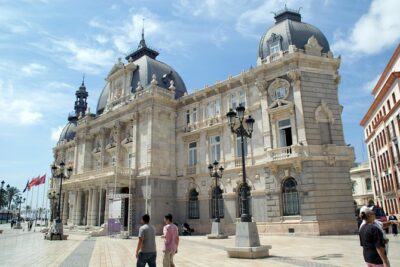
Shore Excursion: Cartagena Half-Day Private Tour with transport
Read our review →Browse the lists this tour appears in