
Review · SPLIT SHORE EXCURSIONS
Split and Trogir Half Day Tour from Split (with port pickup)
Two historic cities, one well-used morning.
This four-hour outing gives you a smart way to pair Split’s Roman core with the smaller, quieter streets of UNESCO-listed Trogir. I like the port pickup, which removes the usual cruise-day guesswork, and I like the chance to hear local stories from guides such as Tina, Sandra, Roko, and Hrvoje. Their personal touch, humor, and clear explanations are repeatedly praised.
The main drawback is the pace. You cover a lot in four hours, with plenty of walking and limited free time. The group can reach 50 people, though some departures have had only seven or so. Entry fees, food, drinks, and the return to the ship are not included, so you need to plan for those details.
Key points to know before booking
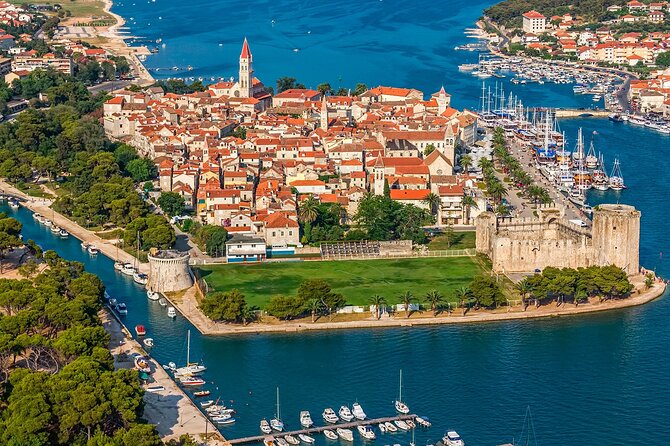
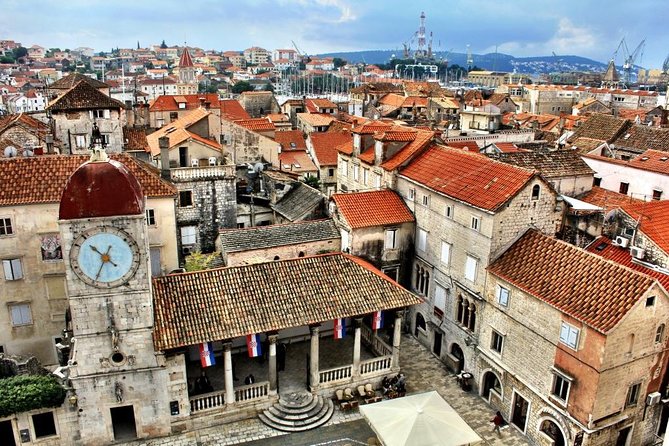
- Two major Croatian sights in four hours: See Trogir’s medieval center and Split’s Diocletian’s Palace in one compact outing.
- Built for cruise passengers: Pickup is at the cruise terminal, and the tour ends on Split’s Riva, about a 20-minute walk from the ship.
- Strong local guiding: Tina and Sandra receive especially warm praise for their storytelling, care, and practical advice.
- Expect real walking: Cobblestones, historic lanes, stairs, and standing during explanations make moderate fitness useful.
- Coach travel is comfortable: The air-conditioned vehicle helps with the short coastal transfer between Split and Trogir.
- Bring extra money: Admission fees, food, and drinks are separate, and the price is $78.61 per person.
Why this pairing works so well
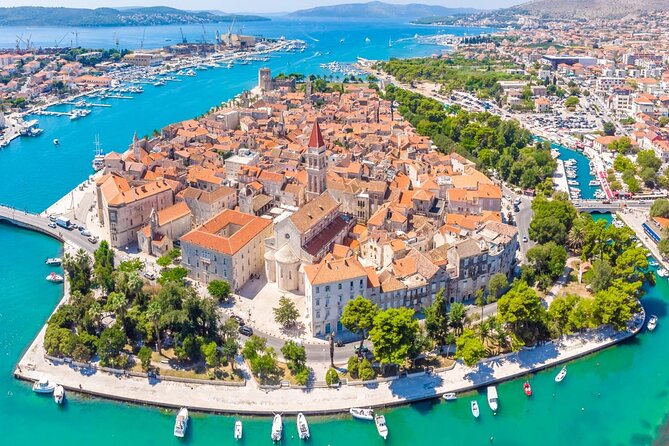
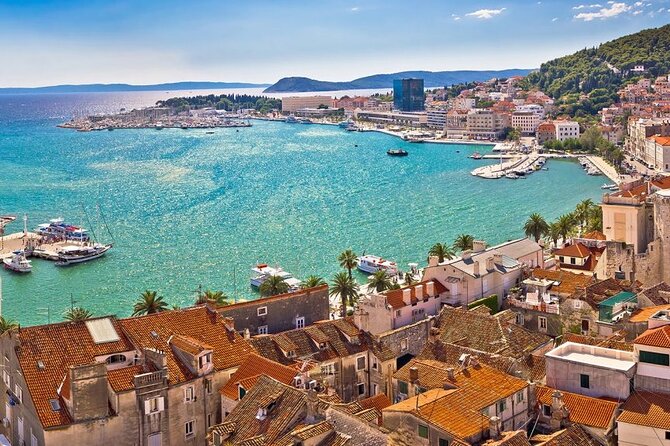
Split and Trogir are close enough to combine, yet they feel quite different. Split is a living city built around the enormous palace of Roman emperor Diocletian. Shops, cafés, homes, restaurants, and narrow lanes now occupy much of the old palace complex.
Trogir is smaller and more compact. Greek colonists founded it in the third century BC, and its urban story has continued for about 2,300 years. Romanesque churches, Venetian buildings, fortress walls, and a waterfront setting give the town a different mood from Split.
That contrast is the real value of the tour. You are not spending four hours looking at similar monuments. You get a broad look at Croatia’s Roman, medieval, Renaissance, Baroque, and modern layers, with a guide to connect the pieces.
The tour is also a good fit for a port day because transportation is arranged. You do not have to work out a local bus, taxi, or rental car while watching the clock. The drive along the coast is short, and the air-conditioned coach gives you a break from walking in hot weather.
More Shore Excursions with Port Pickup in Croatia:
- Mykonos Shore Excursion with Pickup from Cruise Ship Terminal
★ 4.5 · 766 reviews - Mykonos Small Group Tour for Cruise Passengers — Port Pickup
★ 5.0 · 597 reviews - Mykonos: Small Group Tour for Cruise Passengers —Port Pickup
★ 4.9 · 292 reviews
Meeting the guide at Split’s cruise terminal
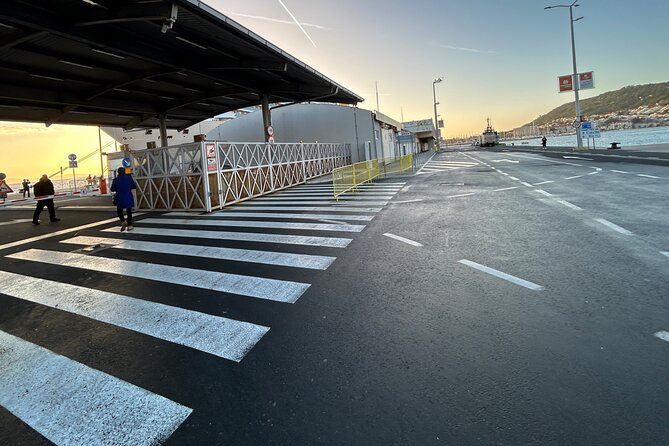
Cruise passengers meet at the New Split Berth for Cruising Ships, at Obala kneza Domagoja 16. The guide carries a Croatian Trails sign and waits at the entrance to the ship terminal, next to the red hop-on hop-off buses, past the fence as you leave the ship.
This detail matters. The pickup instructions specifically warn you not to rely on general directions from other people in the port. Look for the sign and the red buses.
The timing depends on your ship’s schedule. For an early arrival between 7:00 and 8:30 in the morning, pickup is listed as 9:00. If your ship arrives later, exact instructions are sent through Viator messaging about a week before the tour. At booking, cruise passengers must provide the ship name, docking time, disembarkation time, and re-boarding time.
Read those instructions carefully. One unhappy departure involved confusion over a 9:00 versus 10:30 start, apparently linked to the disembarkation time supplied during booking. This is the sort of small port detail that can sour an otherwise good morning.
Trogir’s compact old town
The day generally begins with the short ride to Trogir, although the listed stops are presented in a mixed order. Once there, you have about an hour to explore the historic center, with guided attention to places such as the Cathedral of St. Lawrence and Kamerlengo Fortress.
Trogir rewards slow looking. Its narrow streets are lined with Romanesque and Gothic details, while later Venetian buildings show how the town changed under successive rulers. The center is compact enough to cover on foot, but the stone paving can be uneven.
The Cathedral of St. Lawrence is the town’s most imposing building. Construction lasted for several centuries, so the basilica brings together several styles used in Dalmatia over time. That makes it more interesting than a monument built in one clean architectural period.
Kamerlengo Fortress offers another side of Trogir. Built in the mid-15th century as part of the town’s defenses, it now hosts summer performances. The fortress is a useful reminder that Trogir was not simply a pretty waterfront town. It was also a fortified port with political and military importance.
You may have a little time for shopping, food, or a quick local treat. One guide specifically recommended gelato in Trogir, and another departure included samples of local liquor and cheese. Those extras are not guaranteed, so treat them as guide-dependent rather than promised parts of the tour.
The one-hour Trogir visit is enough to get a feel for the town, but not enough for a leisurely museum visit, long meal, and relaxed photography session. If Trogir is your main reason for coming to Croatia, you will want more time on a separate visit.
Returning to Split and entering Diocletian’s Palace
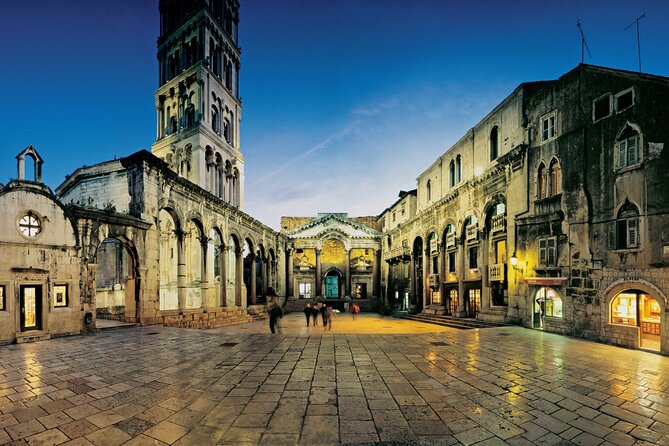
Split’s old town is unusual because it is not simply beside a Roman monument. Much of it is inside one. Diocletian built his palace at the turn of the fourth century AD, and its remains now form roughly half of Split’s old town and city center.
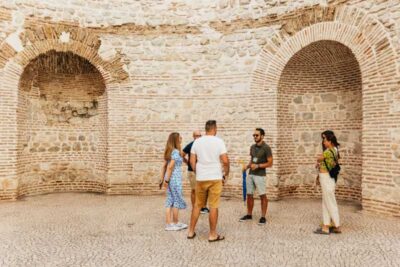
The guided portion lasts about 20 minutes at the palace. That is a short introduction, not an exhaustive archaeological tour. Still, a good guide can help you understand the odd mix of ancient stone, later homes, shops, cafés, and public spaces.
Tina is especially well regarded for making the palace and the city’s past easy to follow. She is described as a local schoolteacher with excellent English, strong organization, and a lively sense of humor. Sandra is also praised for combining facts with personal stories and practical suggestions for restaurants and shops.
After the structured portion, you may have some time to explore independently, depending on traffic, group movement, and the exact schedule. The tour information also lists the Cathedral of Saint Domnius as a 20-minute stop. Strictly speaking, the cathedral complex combines a church dedicated to the Virgin Mary with a bell tower dedicated to Saint Domnius. The building began as Diocletian’s imperial mausoleum, which gives the site an unusual Roman-to-Christian story.
Admission is not included for Diocletian’s Palace or the cathedral. You should ask the guide how much time is available before paying for an optional entrance, since a short stop may not allow a full visit.
A few more shore excursions around Croatia worth a look
- Split and Trogir Half Day Tour from Cruise Ships
★ 4.8 · 599 reviews - Split and Trogir private tour *ideal for cruise ship guests*
★ 5.0 · 210 reviews - Dubrovnik Shore Excursion: Explore Dubrovnik by Cable Car (ticket included)
★ 4.5 · 109 reviews - Private Krka Waterfalls with Wine and Prosciutto Shore Excursion
★ 5.0 · 98 reviews
Prokurative and the final walk to the Riva
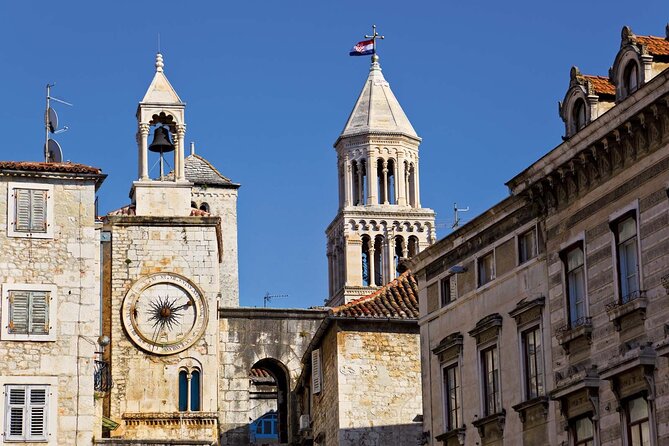
The tour also includes Prokurative, officially known as Republic Square. This 19th-century square was developed under General Marmont and Split mayor Antonio Bajamonti. Its design recalls Italian architecture, especially Venice’s St. Mark’s Square, and the architect himself came from Venice.
The stop lasts about 15 minutes. That is enough for an explanation, photographs, and a quick look around, but not a long café break.
The official ending point is Split Riva, the waterfront promenade in the city center. There is no included drop-off at the port. From the Riva, the walk back to the cruise terminal takes about 20 minutes, and the guide can help you arrange a taxi if needed.
For most cruise passengers, the walk is a useful part of the plan rather than a problem. You finish in the center, close to cafés, shops, and additional sights. But allow extra time. A four-hour tour does not mean you are back at the ship four hours after pickup, especially if you stop for lunch or wait for a taxi.
How much walking and waiting should you expect?

This is not a bus tour where you look out the window and step off only for photographs. You will walk through old-town streets, stand while the guide explains monuments, and move over historic paving.
One person classified the outing as a moderate Level 2 because of the amount of walking. That matches the practical reality. You do not need an athlete’s fitness, but comfortable shoes are important. In hot weather, carry water and use the coach as a chance to cool down.
The tour operates in all weather. Bring suitable clothing for sun, wind, or rain. One departure continued in heavy rain and still produced a worthwhile day, while another lost part of the planned visit because rain and severe traffic consumed too much time. Traffic is the bigger concern on a cruise schedule because transfer times are approximate.
The coach is air-conditioned, which several positive accounts found helpful. That comfort matters in summer, when Split’s stone streets can hold heat.
Guides are the main strength
The clearest pattern is the quality of the guiding. Tina is praised for her energy, organization, humor, and ability to adjust to different needs. Sandra receives similar praise for her passion, friendly manner, and restaurant and shopping advice. Roko is described as fun, professional, and especially effective at bringing the past to life. Hrvoje is also praised for his clear explanations of Trogir and Split.
That does not guarantee a particular guide on your date. It does show what the company’s best guides add: context, local perspective, and help when the group needs to adjust.
The personal element matters in a place like Diocletian’s Palace. Without explanation, you can see columns, arches, and old stone but miss how the Roman structure became a working neighborhood. In Trogir, a guide helps you see why a small church doorway, Venetian façade, or defensive wall matters.
The group size needs a realistic reading. The maximum is 50 people, but some departures have been much smaller, including one with seven participants. A small group feels more personal and makes questions easier. A full coach will feel less intimate, though the guide usually uses the same route and commentary.
Is $78.61 a fair price?
At $78.61 per person, this is not the cheapest way to reach Trogir and Split. You are paying for port pickup, an air-conditioned coach, a professional guide, live commentary, and the convenience of combining two places during a single morning.
For a cruise passenger, that convenience has real value. Missing a ship is far more expensive than paying for organized transport, and you avoid the uncertainty of finding a taxi or coordinating public transportation. The guide also handles the transition between two historic centers, which saves planning time.
The price is less attractive if you are staying in Split for several days. You could explore Split independently, spend a full day in Trogir, and choose your own meal and museum schedule. Independent visitors should compare the tour cost with local transport and any admission fees, then decide how much they value expert commentary.
Remember that food, drinks, and entry fees are extra. The tour is best viewed as a guided transport and orientation service, not an all-inclusive day out.
Who should book this half-day outing?
I would choose this for a cruise stop, a first morning in Split, or a short stay when you want a useful introduction without arranging everything yourself.
It suits you if you:
- Want to see both Split and Trogir in one morning
- Prefer a guide to explain the monuments
- Value pickup near the ship
- Are comfortable walking on old stone streets
- Like a structured visit with some independent time
- Need to finish in central Split rather than at the port
I would hesitate if you want a slow visit, extensive interior access, or a private experience. The schedule is tight, the group may be large, and the tour does not include port drop-off. It is also not ideal if heat, rain, or long periods of standing are difficult for you.
Final verdict: book it for convenience and context
I recommend this tour most strongly to cruise passengers who want a safe, efficient introduction to two important Croatian towns. The combination of Trogir’s compact medieval center and Split’s Roman palace gives you a useful first look at the region, while guides such as Tina and Sandra add warmth and local detail.
Book it with realistic expectations. You will not see every corner, and traffic or weather can shorten the program. Confirm your pickup time, follow the terminal directions, wear good shoes, and leave room in your budget for admissions and the walk back to the ship.
If you have several days in Split, I would spread these visits out. If you have only one port morning, this is a strong, practical choice.
FAQ
How long does the Split and Trogir tour last?
The tour lasts approximately four hours. Transfer times can vary with traffic and the time of day.
Where does cruise pickup take place?
Pickup is at the New Split Berth for Cruising Ships, Obala kneza Domagoja 16, Split. The guide carries a Croatian Trails sign and waits near the red hop-on hop-off buses at the terminal entrance.
Where does the tour end?
The tour ends at Split Riva in the city center. Drop-off at the ship terminal is not included. The walk back to the terminal takes about 20 minutes, and the guide can help you find a taxi if needed.
Is food included?
No. Food and drinks are not included in the price.
Are admission fees included?
No. Entry fees are separate. Admission is listed as not included for Diocletian’s Palace, the Cathedral of Saint Domnius, and Kamerlengo Fortress. Some outdoor or city-center stops have no admission charge.
How many people can join the tour?
The activity can include a maximum of 50 people. Some departures may be smaller.
What happens if my cruise ship is late?
You must provide your ship’s docking, disembarkation, and re-boarding details when booking. Refunds are not issued if you miss the tour because your ship arrives late or does not arrive.
Just added around Croatia
- Dubrovnik Coast and Cavtat Shore Excursion★ 4.0 · 8 reviews
- Total Game of Thrones Shore Excursion★ 5.0 · 4 reviews
- Dubrovnik Above Beyond, Srdj drive & guided Old Town PRIVATE SHORE EXCURSION★ 5.0 · 48 reviews
- Dubrovnik Shore Excursion: Old Town Walking Tour★ 4.0 · 16 reviews
- Dubrovnik Shore Excursion: City Walls Walking Tour (entrance ticket included)★ 4.5 · 28 reviews
- Dubrovnik Private Shore Excursion: Dubrovnik Old Town, Konavle Valley and Sivi Soko Viewpoint★ 5.0 · 2 reviews
- Split and Trogir private tour *ideal for cruise ship guests*★ 5.0 · 3 reviews
- Split and Trogir SMALL GROUP Tour with Cruise Ship Drop Off★ 5.0 · 7 reviews
Split Shore Excursions, compared.
Split and Trogir Half Day Tour from Cruise Ships
Read our review →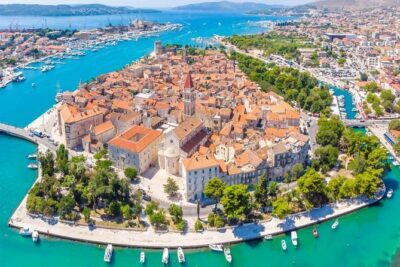
Split and Trogir private tour *ideal for cruise ship guests*
Read our review →
Private Krka Waterfalls with Wine and Prosciutto Shore Excursion
Read our review →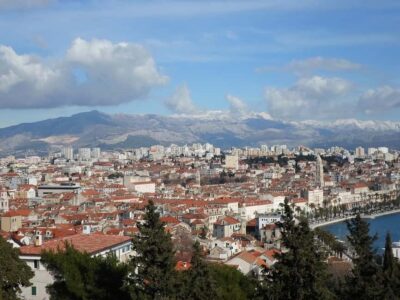
Split and Trogir SMALL GROUP Tour with Cruise Ship Drop Off
Read our review →Browse the lists this tour appears in